Part 1 / 6 min read / April 14, 2026
Mat Time Is King, But It Is Not The Whole Kingdom
Mat time is irreplaceable, but the hours after class do not have to be dead time. Good technique notes can protect the details you already earned.
Everyone in Jiu-Jitsu wants the same thing.
You want to get better faster.
Not in the fake shortcut way. Not by collecting random Instagram techniques or jumping from one instructional to another every week. You want the real version: better timing, cleaner movement, better retention, fewer repeated bad habits, and more confidence when a position shows up during a roll.
The usual answer is simple: train more.
That answer is mostly correct. Nothing replaces mat time. You need live resistance. You need pressure. You need to feel balance, grips, weight, frames, fatigue, panic, timing, and the weird little adjustments that only become obvious when another human being is trying to stop you.
But there is a second part that most people ignore.
Training does not end when class ends.
The Problem: You Forget More Than You Think
Think about the last class you attended.
You probably remember the general topic. Maybe it was half guard passing, armbar defense, single-leg X, back control, or a detail from side control.
Now try to remember the exact sequence.
Where was your first grip? What made the move work? Was your elbow inside or outside? Which direction did you shift your weight? What body cue told you the setup was right? What detail did the coach repeat three times?
For most people, those details fade quickly.
That is not because they are lazy. It is because BJJ is dense. A normal class can include warmups, technique, variations, resistance rounds, sparring, coach feedback, and a dozen small corrections. Then you leave the gym tired, hungry, and distracted.
By the next morning, the technique often becomes a vague idea:
"We did something from knee shield."
That is not enough to build a game.
The Better Question
Instead of only asking, "How can I train more?", ask:
How can I keep more of what I already train?
That question changes everything.
If you train three times per week but forget half the details, you are leaving progress on the table. If you spend five minutes in the app after class capturing the most important idea, you are not replacing training. You are protecting it.
You are making the session last longer in your mind.
Why Off-Mat Review Can Help
Motor learning is not purely physical. Physical practice is the foundation, but the brain continues to process movement through attention, memory, imagery, and review.
This is why serious athletes use journaling, video, visualization, feedback, and self-regulated planning. They are not pretending those things replace practice. They are using them to make practice more productive.
In the research, a few ideas are especially relevant to BJJ:
- Motor imagery means mentally rehearsing a movement without physically doing it. This is not daydreaming. Good imagery is specific: grips, pressure, angle, weight shift, timing, and finish.
- Action observation means watching movement with attention and intent. For a BJJ athlete, this can include watching a coach demonstrate, reviewing a short clip, or mentally reconstructing a movement from class.
- Self-regulated learning means planning, monitoring, and adjusting your own training instead of just showing up and hoping improvement happens automatically.
- Spaced retrieval means revisiting information over time and trying to recall it before looking it up. This is one of the strongest findings in learning science, and it fits technique review well.
The practical takeaway is simple:
You can get more value from class by reviewing what happened, mentally rehearsing what you learned, and bringing a clear intention into the next session.
A Quick Note On "Mirror Neurons"
You may have heard the term "mirror neurons." The basic idea is that some motor-related systems are active when we perform actions and also when we observe or mentally simulate actions.
That idea is relevant, but it is easy to overstate.
It would be too strong to say, "Reading your notes activates mirror neurons and makes you better at BJJ." Passive reading is not enough.
A better way to think about it is this:
When you review a technique, do not just read the words. Use the words to recreate the movement in your mind.
If your note says, "Win the underhook, come up to dogfight, block the far knee," you should feel that sequence mentally. Picture the shoulder pressure. Imagine your head position. Feel the underhook. Check whether your hips, frames, and base are doing the job.
That is much closer to useful mental practice.
The Five-Minute Habit Inside The App
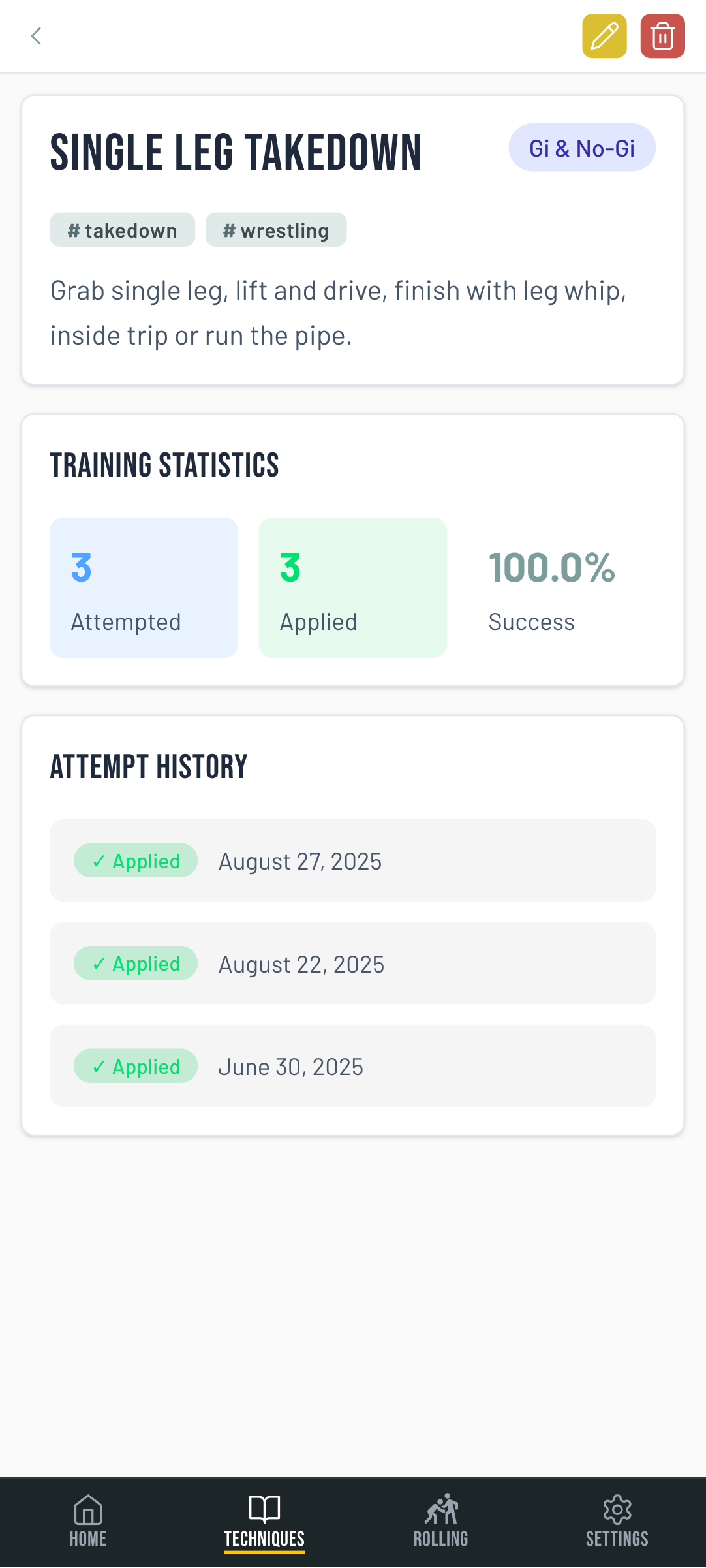
Right after class, open the app and write down the techniques, concepts, and movement cues worth keeping.
Not a perfect transcript of class. The useful parts.
The goal is not to produce a perfect encyclopedia. The goal is to capture enough detail that your future self can rebuild the movements that mattered.
Use this structure:
- Position: Where did the technique start?
- Setup cue: What body position or grip made the move available?
- Controls: What grips, frames, hooks, or pressure mattered most?
- Movement: What were the key steps?
- Checkpoint: What should the movement feel like when it is working?
- Training goal: How will I commit to testing this technique in a roll?
Here is an example:
Position: knee shield half guard.
Setup cue: partner's weight is forward enough that my knee shield can make space.
Controls: inside frame plus underhook before coming up. Head tight under their chin. Do not reach with the outside arm.
Movement: underhook, come to elbow, build to hand, keep chest connected, then attack the knee tap or dogfight.
Checkpoint: I should feel my head tight and my hips coming underneath me before I reach.
Training goal: test the knee shield underhook to dogfight at least once in a roll.
That note is short, but it gives you something to review.
More importantly, it gives you something to train.
Remember Techniques In Context
This is important.
Remembering more techniques is useful when those techniques stay connected to positions, cues, controls, and goals.
A good training log should help you turn random classes into a connected system. One escape connects to a guard retention habit. One passing detail connects to a recurring position. One back attack connects to a goal you can keep visible before class.
You are not just writing:
"Today we did butterfly sweep."
You are building:
"From shin-to-shin or butterfly, I can create off-balance when their weight is forward. I need the grip, the angle, and my hips underneath me before I come up or return to guard."
That is how techniques become a game.
What To Do Before Your Next Class
Before your next session, open your recent notes in the app.
Do not read them immediately.
First, try to recall the techniques or cues from memory. Ask yourself:
- Where did it start?
- What was the first grip or frame?
- What was the key detail?
- What movement cue did I need to remember?
- Where can I try this today?
Then read your note.
Close your eyes for 20 seconds and mentally rehearse the movement. Keep it first-person. Imagine you are doing it, not watching yourself from across the room.
Then pick a clear intention for class:
"Today, if I get knee shield, I am going to fight for the underhook immediately."
That intention is the bridge from technique notes to training goals. The Goals section of the app is where that commitment becomes a live-roll test you can mark as active, achieved, or dropped, then connect to the roll where it happened.
That is it.
Notes. Review. Intentional training.
The Bottom Line
The people who get better fastest are not always the people who know the most techniques.
They are usually the people who turn experience into feedback.
They notice what happened. They remember what mattered. They bring a specific focus into the next round. They build connections between classes instead of treating each session like a separate event.
Mat time is still king.
But if you want to get better at BJJ faster, stop letting class end when you leave the gym.
Write down what you learned. Review those notes. Mentally rehearse the movement. Bring the details back to the mat.
That is how one class becomes more than one class.
Science Notes
- Mental practice has a small but meaningful positive effect on performance, although it is not as strong as physical practice. That supports using mental rehearsal as a supplement, not a replacement.
- Action observation and motor imagery both relate to motor learning, especially when they are active, specific, and paired with physical practice.
- Self-regulated learning research in sport supports the idea that planning, monitoring, and reflecting are part of serious practice.
Sources
- Toth et al., "Does Mental Practice Still Enhance Performance? A 24 Year Follow-up and Meta-Analytic Replication and Extension"
- Eaves et al., "Motor Imagery during Action Observation: A Brief Review of Evidence, Theory and Future Research Opportunities"
- Bartulovic et al., "A Two-Phase Evaluation of the Validity of a Measure for Self-Regulated Learning in Sport Practice"
TLDR
Getting better at BJJ is not only about training more. It is also about keeping more of what you already train. Notes, review, and clear intentions can make your next class more useful.
Turn one class into repeatable reps.
Log the techniques worth keeping, review them before your next session, and walk onto the mat with a clear intention.
Start Free