Part 4 / 7 min read / April 14, 2026
From Technique Notes To Training Goals
A technique note helps you remember the movement. A training goal makes you decide how you will test it on the mat.
In the first post of this series, the technique-note template ended with a training goal: how will I commit to testing this technique in a roll?
This post is the next step. If the technique note is where you capture the clean version of the movement, the Goals section is where you turn that note into a training decision.
That is the app's practical version of self-regulated learning.
Goals Are The Self-Regulated Learning Loop
Self-regulated learning is not a complicated idea.
For training, it means you do three things on purpose:
- Set a target before practice.
- Pay attention to what happens during practice.
- Reflect afterward and decide the next step.
The Goals feature exists to make that loop visible in the app.
A technique note helps you remember the movement. A rolling-session note helps you record what happened against resistance. A goal sits between them: it says what you are going to bring back to live training.
That distinction matters.
In a technique note, you might write:
Movement checkpoint: head stays tight and hips come underneath me before I reach.
That is a movement cue.
In a goal, you might write:
Keep knee shield half guard and prevent the pass, then look for the underhook when the inside shoulder is clear.
That is a training target. It gives you something to test in a roll.
What The Goals Feature Does
In the app, a goal can do a few useful things.
You can give it a clear title, add a description, and keep its status as Active while you are still working on it.
You can link it to a related technique when the goal comes from a technique note.
You can mark it Achieved when you complete the test, or Dropped when it is no longer useful.
When you mark a goal as Achieved, you can also choose the rolling session where it happened. That keeps the goal connected to the real round, not just to the idea you had after class.
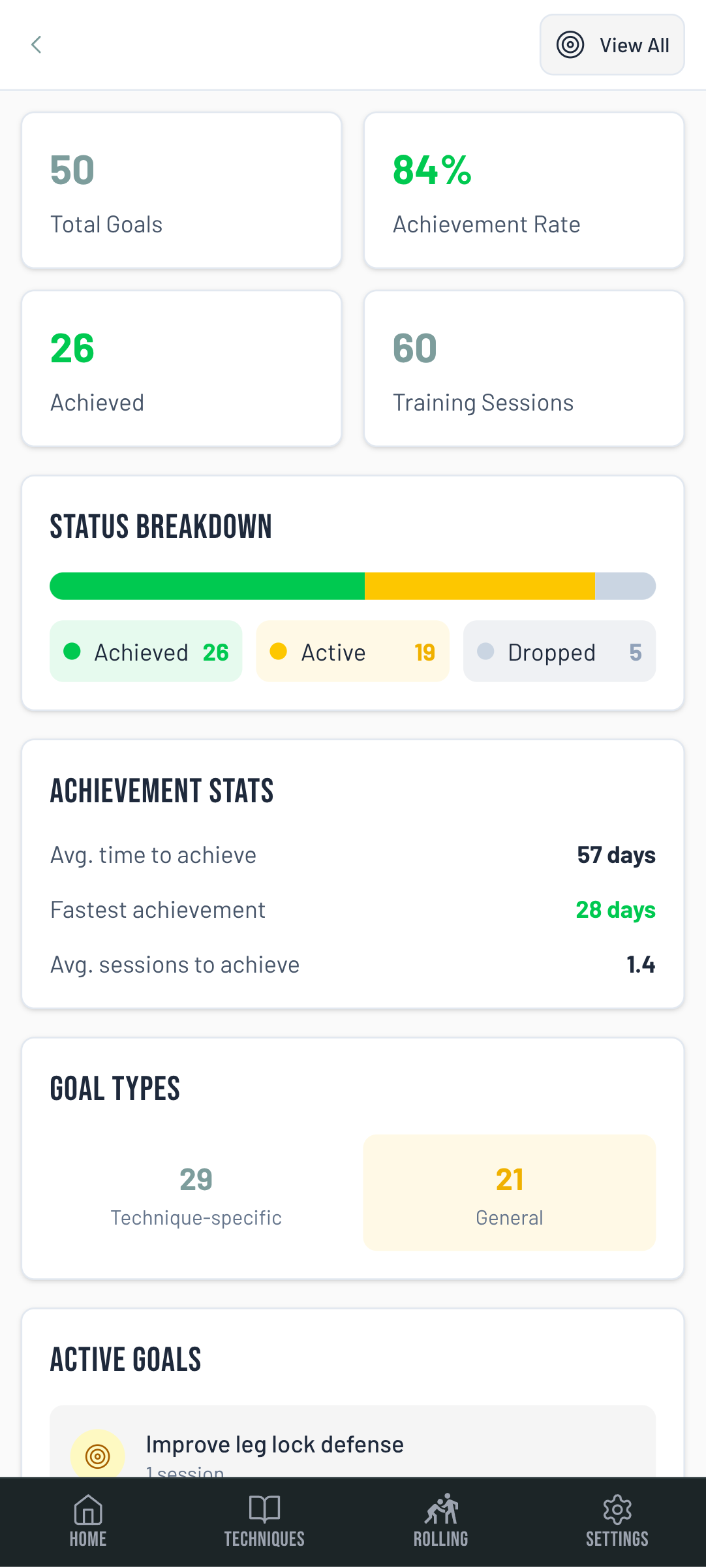
The goals list lets you search, filter by status, and keep active targets easy to find. The insights screen can summarize things like active goals, achieved goals, dropped goals, achievement rate, and whether your goals are technique-specific or more general.
That is enough structure to close the loop:
Note the technique. Create the goal. Test it in training. Mark what happened.
Start From The Technique Note
The easiest place to create a goal is after writing a technique note.
Use the final line of the note as a prompt:
What am I committing to test in a live round?
Then open Goals and write that commitment in plain language.
For example:
- "Keep knee shield half guard and prevent the pass for one exchange."
- "Test the knee shield underhook to dogfight at least once in a roll."
- "Recover inside frames from side control before bridging."
- "Use the collar-sleeve guard retention cue against a standing passer."
- "Break posture from closed guard before attacking the armbar."
These goals are not just tiny mechanical reminders.
"Build to my elbow immediately after I clear the inside shoulder" is useful as a technique cue, but it is too narrow to be the whole training goal. The goal should describe the position or skill you are trying to test under live conditions.
The cue belongs inside the technique note. The goal belongs in the Goals section.
Write The Goal So You Can Judge It Later
A good BJJ goal should be easy to answer after training.
Ask:
- What position am I trying to reach or keep?
- What skill am I trying to test?
- What would count as a real attempt?
- What would count as completed?
For knee shield half guard, a useful goal could be:
Title: Keep knee shield half guard and prevent the pass.
Related technique: underhook from knee shield to dogfight.
Description: In at least one roll, keep the knee shield long enough to stop the pass, clear the inside shoulder, and look for the underhook. If the partner whizzers, backsteps, or smashes the shield, write that in the rolling-session note.
Notice what the goal does.
It does not try to predict every partner reaction. That belongs in the roll afterward.
It sets a test.
After The Roll, Update The Right Record
After training, split the information into the right place.
If the problem was your movement, update the technique note. Maybe your head was too low. Maybe your hips stayed flat. Maybe the grip order was wrong.
If the problem was live resistance, update the rolling-session note. Maybe your partner whizzered hard. Maybe they backstepped. Maybe they flattened your knee shield before you could build to the elbow.
Then update the goal.
If you completed the test, mark the goal Achieved and link the rolling session where it happened.
If it is still useful, leave it Active.
If it no longer fits your training, mark it Dropped. Dropped is not failure. It is information. It means you made a decision instead of letting an old target sit there forever.
How This Helps Your Training
Goals help because they narrow attention before the round starts.
That does not mean every roll becomes rigid or artificial. You still train with what the round gives you.
But a goal makes you more likely to notice the right moment when it appears.
If your active goal is knee shield retention, you will notice when you enter half guard. You will notice whether your knee line is safe. You will notice whether the inside shoulder is blocked. You will notice whether you actually tried the underhook, or whether you abandoned the position immediately.
That is self-regulated learning in practice.
You are not waiting for improvement to happen randomly. You are choosing a focus, testing it, and feeding the result back into your notes.
Use Insights As A Check
The insights screen is not there to make the app feel like a scoreboard.
Use it as a check on your training direction.
If all your goals are active and none are achieved or dropped, you may be collecting intentions without closing them.
If every goal is technique-specific, you may need a broader positional focus.
If every goal is broad, you may need to link some of them back to concrete technique notes.
The useful question is simple:
Are my goals helping me decide what to train next?
The Bottom Line
Technique notes preserve details.
Rolling-session notes preserve live feedback.
Goals connect the two.
When you create a goal in the app, you are choosing what your next experiment on the mat should be. When you mark it achieved, dropped, or still active, you are reflecting on that experiment.
That is why goals are not just a productivity feature.
They are how the app turns self-regulated learning into something you can actually do after class and before the next roll.
Science Notes
- Self-regulated learning in sport includes planning practice, monitoring what happens, and reflecting afterward. A training goal gives that loop a concrete target.
- Martial arts research has linked traditional training with self-regulatory development, which supports treating BJJ progress as more than just accumulated repetitions.
- Taekwondo athlete research identifies goal setting as one of the core psychological skills used in combat-sport performance, although that does not mean every BJJ goal should be competitive or outcome-based.
Sources
TLDR
A technique note remembers the movement. A training goal makes you test it. In the app, create a goal, keep it active while you train, then mark it achieved or dropped and link the achieved goal to the roll where it happened.
Turn one class into repeatable reps.
Log the techniques worth keeping, review them before your next session, and walk onto the mat with a clear intention.
Start Free