Part 2 / 7 min read / April 14, 2026
The 5-Minute Technique Note: How To Remember What You Learned In BJJ Class
Most BJJ notes are either too vague to help or too detailed to maintain. This template gives you a faster way to capture what matters.
Most BJJ notes are either too vague to help or too detailed to maintain.
Too vague looks like this:
"Arm drag to back."
You will read that two weeks later and remember almost nothing.
Too detailed looks like a legal document:
"Right hand controls partner's left wrist at 30 degrees, left hand reaches across the triceps while shifting hips laterally..."
That might be accurate, but most people will not keep doing it after a hard night of training.
The best notes are the ones you can actually write.
It should take five minutes. It should capture the important details. It should help you recall the movement later. It should give you clear focuses to bring into future training.
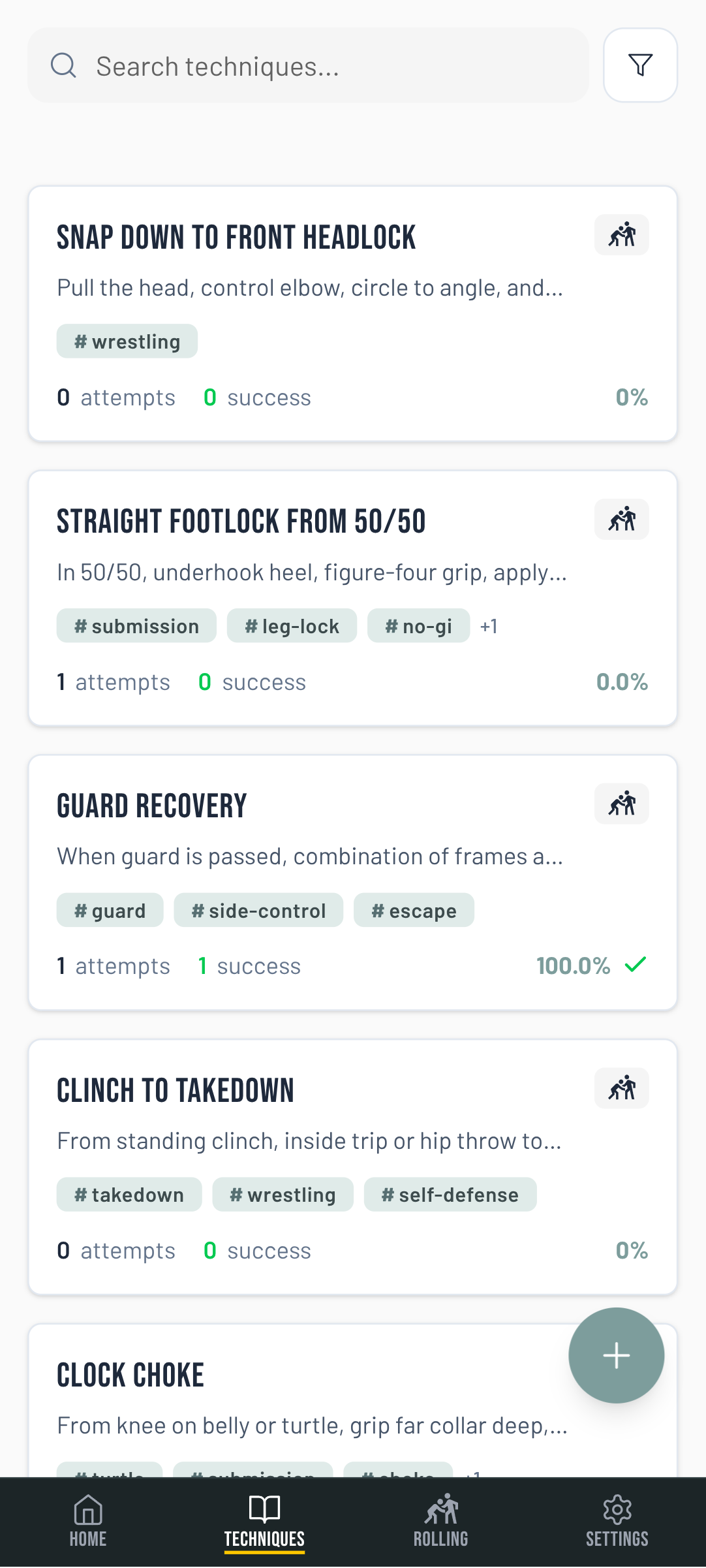
The app makes that habit easier because notes are typed, searchable, and connected to your own training history. But the app is only the container. The real value is the way you think while writing.
This is not about becoming a full-time BJJ blogger. It is about building a memory system for your own game.
Why Technique Notes Work
Writing after class forces you to decide what mattered.
That alone is valuable.
When you train, everything is happening at once: grips, pressure, fatigue, coach feedback, movement cues, your own body awareness, and the constant problem of trying to make your body do something it does not yet understand.
If you do not review the session, the loudest memory usually wins. Maybe you remember getting smashed. Maybe you remember hitting one sweep. Maybe you remember the final roll more than the technique portion.
Short notes help separate signal from noise.
What did I learn that I want to bring back?
That is a different level of training.
The Technique Note Template
Use this format after class.
You do not need perfect grammar. You do not need long paragraphs. You need useful recall cues.
1. Position
Where does the technique start?
Examples:
- closed guard
- knee shield half guard
- headquarters passing
- side control top
- turtle attack
- back control with seatbelt
- single leg defense
This matters because techniques are not isolated. They belong to positions. If you do not know where the move starts, you will struggle to recognize it when that position appears again.
Bad note:
"Sweep."
Better note:
"Butterfly guard against kneeling partner with hands on the mat."
The better note gives your future self a place to begin. It tells you where the movement lives.
2. Setup Cue
What makes the technique available?
This is one of the most important parts of the note.
Beginners often think techniques are things you choose randomly. Advanced practitioners understand that techniques appear because a specific body position, grip, angle, or weight distribution makes them available.
Examples:
- their hand is on the mat
- their weight is forward
- one leg is close enough to enter
- their knee is turned inward
- the elbow line is exposed
- the neck is open after hand fighting
- your frame has made enough space
If you know the setup cue, you can recognize the moment.
Bad note:
"Do scissor sweep."
Better note:
"Scissor sweep when they are kneeling with weight forward and I have sleeve plus collar control."
That difference matters. The first note names a move. The second note tells you when the move exists.
3. Controls
What has to be controlled before the movement works?
In BJJ, the visible movement is usually not the real technique. The real technique is control.
A sweep is not just the sweep. It is the grips that stop the post. It is the angle that removes balance. It is the frame that keeps their weight where you need it.
Write down the controls:
- sleeve grip
- collar grip
- underhook
- crossface
- head position
- hip connection
- knee line
- inside position
- far wrist
- near elbow
Ask yourself:
If I miss this control, does the technique fail?
If the answer is yes, put it in the note.
This is where the app can become more than a list of techniques. Over time, you start seeing patterns. Maybe every guard recovery note mentions inside position. Maybe every back attack note mentions controlling the top hand. Maybe every passing note mentions losing head position.
Those patterns are your actual game talking back to you.
4. Key Movement
Now write the movement, but keep it short.
You are not trying to write every possible detail. You are trying to create a map.
Use simple language:
"Pull them forward, angle hips out, chop knee, lift sleeve, come up on top."
That is enough if the setup cue and controls are clear.
If your movement section is getting too long, you are probably trying to write a full instructional. Do not do that after class. Capture the spine of the technique and leave room to update it after you test it.
5. Movement Checkpoint
What should the technique feel like when it is on track?
This keeps the note focused on your movement instead of turning every technique entry into a roll recap.
During the technique portion of class, your partner is often giving you a clean look. They are not trying to win the exchange. That means the most useful note is usually about your mechanics: where your head goes, what your hips do, where your weight should be, and what has to stay connected.
Write a checkpoint that helps you know whether the movement is correct.
Examples:
- "My head stays tight before I build up."
- "My hips move first, then my arms pull."
- "I should feel their weight loaded before I chop the knee."
- "My elbow stays inside until the angle is made."
- "I can pause with control before I finish."
This is where technique notes stay different from rolling notes.
If you later test the move in a roll and your partner whizzers, backsteps, frames, or stalls, write that in the rolling-session note. That is valuable information. It just belongs to the live exchange, not the clean technique note.
6. Training Goal
End the note with a concrete commitment to test the technique in a roll.
This is not another movement cue. In the technique portion of class, you are usually seeing the clean version of the move. The final line should point forward: where will you try to make this technique show up in live training?
This is also the handoff from a technique note to the Goals section of the app. Create a goal for the test, track whether you completed it, and connect it to the roll where it happened.
Examples:
- "Test the knee shield underhook to dogfight at least once in a roll."
- "Try the scissor sweep from closed guard in one live round."
- "Attempt the back take from turtle during positional sparring."
- "Use the new passing entry once against open guard."
Without a goal, notes become storage.
With a goal, the note becomes something you can bring back to class.
The next post goes deeper on using Goals in the app to track that focus across sessions.
A Complete Example
Here is what a good five-minute note might look like in the app.
Technique: underhook from knee shield to dogfight.
Position: bottom half guard with knee shield.
Setup cue: partner's weight is forward and my inside shoulder is clear.
Controls: inside frame, knee shield distance, underhook, head tight to chest or under chin.
Movement: remove knee shield, come up to elbow, build to hand, stay connected, attack knee tap or come to dogfight.
Movement checkpoint: head stays tight and hips come underneath me before I reach.
Training goal: test the knee shield underhook to dogfight at least once in a roll.
That note is short.
But it gives you a position, a setup cue, a control priority, a movement checkpoint, and a goal to carry forward.
That is enough to improve.
How To Review The Note
The review matters as much as the writing.
Do not just reread notes like receipts.
Use active recall.
Before looking, ask yourself:
- What position was this from?
- What was the setup cue?
- What grip or control mattered most?
- What movement checkpoint should I feel?
- What goal did I create from this?
Then check the notes.
If you forgot something, that is not failure. That is the point. Retrieval tells your brain what needs to be strengthened.
Then mentally rehearse the technique once or twice.
Not from a camera angle. From your own body.
Feel the grip. Feel the pressure. Feel the hip movement. Keep the image focused on your own mechanics.
This turns a written note into something closer to a mental rep.
What Not To Do
Do not try to write a full instructional for every technique after class.
That sounds disciplined, but it usually turns into too much detail to maintain.
BJJ already has infinite information. Your job is not to collect all of it with equal weight. Your job is to capture the techniques, concepts, and goals that matter for your current game.
Do not only write names of moves.
Move names are useful labels, but they rarely preserve the details that make the move work.
Do not review only when you feel motivated.
The best review habit is small enough that you can do it on a normal day. Two minutes before class is better than a perfect review system you abandon after a week.
Do not treat notes as proof that you learned something.
Notes are only the beginning. The real test is whether they change what you notice and attempt during training.
The Simple Rule
After every class, capture what is worth bringing back.
Some classes give you a main detail. Some give you multiple techniques, a concept, and a goal. Do not force a number. Capture enough that the class does not disappear by tomorrow.
Technique details. Movement cues. Class concepts. Training goals.
Over time, those notes become a map of your actual Jiu-Jitsu.
Not someone else's curriculum.
Not random moves from the internet.
Your positions. Your problems. Your patterns. Your next steps.
That is how a training log becomes useful.
Science Notes
- Self-regulated learning research in sport supports the importance of planning, monitoring, and reflecting on practice.
- Retrieval practice research supports trying to recall information before restudying it.
- The PNAS motor-reactivation study is not a BJJ study, but it supports a useful adjacent idea: brief, accurate reactivation of a motor memory can contribute to learning.
Sources
TLDR
Most BJJ notes fail because they are either too vague or too long. Try this instead: position, setup cue, controls, movement, checkpoint, training goal. Five minutes after class can give your next session a clear purpose.
Turn one class into repeatable reps.
Log the techniques worth keeping, review them before your next session, and walk onto the mat with a clear intention.
Start Free